You are cordially invited to the hybrid book launch of International Law and Posthuman Theory (Routledge, 2024). Present in person will be the two editors (and chapter authors) Dr Matilda Arvidsson (Gothenburg) and Dr Emily Jones (Newcastle, UK), and chapter author Professor Gina Heathcote (Newcastle, UK). Professor Gregor Noll (Gothenburg) will act as discussant and Professor Anne Orford (Melbourne Law School) is also joining in person to launch our book.
Time: Wednesday 16 October, starting at 17:00 (CET) with presentations, discussions, and Q&A.
Venue: Glashuset, Chalmersgatan 4 (Valand Academy of Art).
Online participation: https://gu-se.zoom.us/j/63186226572
No registration needed – all welcome!
About the book: Assembling a series of voices from across the field, this book demonstrates how posthuman theory can be employed to better understand and tackle some of the challenges faced by contemporary international law.
With the vast environmental devastation being caused by climate change, the increasing use of artificial intelligence by international legal actors and the need for international law to face up to its colonial past, international law needs to change. But in regulating and preserving a stable global order in which states act as its main subjects, the traditional sources of international law – international legal statutes, customary international law, historical precedents and general principles of law – create a framework that slows down its capacity to act on contemporary challenges, and to imagine futures yet to come. In response, this collection maintains that posthuman theory can be used to better address the challenges faced by contemporary international law. Covering a wide array of contemporary topics – including environmental law, the law of the sea, colonialism, human rights, conflict and the impact of science and technology – it is the first book to bring new and emerging research on posthuman theory and international law together into one volume.
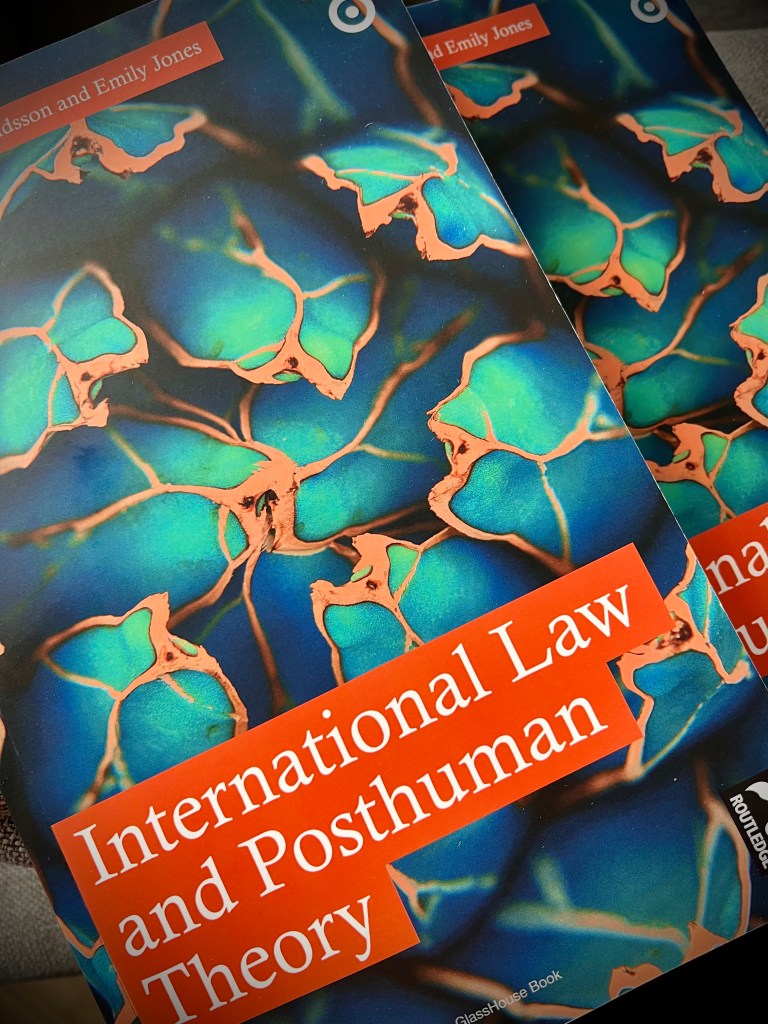
This book’s posthuman engagement with central international legal debates, prefaced by the leading scholar in the field of posthuman theory, provides a perfect resource for students and scholars in international law, as well as critical and socio-legal theorists and others with interests in posthuman thought, technology, colonialism and ecology.
Chapters 1, 9 and 11 of this book is freely available as a downloadable Open Access PDF at: https://www.taylorfrancis.com/books/edit/10.4324/9781032658032/international-law-posthuman-theory-matilda-arvidsson-emily-jones under a Creative Commons Attribution-Non, Commercial-No Derivatives (CC-BY-NC-ND) 4.0 license.
Critics reviews of the book:
“How do ‘we’ move beyond the Eurocentric, hetrosexist and humanistic binds of international law? As much critical scholarship has demonstrated, it is not through more law. This wide-ranging collection, written by some of the most exciting thinkers of international law and posthumanism, provides readers with ways of thinking otherwise – ways out of the binds. This is critique as hope.” Maria Elander, La Trobe University, Australia
“The chapters of this book offer, each in their specific manner and through different angles, multi-directional answers, provide examples and illustrations of what is at stake. They share one, empowering belief, which I take as axiomatic, namely that posthuman legal thought aims to critique the humanistic, Eurocentric, normative and heterosexist core of legal theory and practice, in order to make it more inclusive and less discriminatory. In so doing, they make room for the non-human, more-than-human entities, agents and subjects of our posthuman times. The intertwined critiques of humanism and anthropocentrism serve to illuminate contemporary patterns of power, subjugation, injustice and exploitation. And to offer ways out.” Rosi Braidotti, Utrecht University, the Netherlands.
The authors:
Matilda Arvidsson is Associate Professor in International Law and Assistant Senior Lecturer in Jurisprudence at the University of Gothenburg, Sweden. Her research is interdisciplinary and includes AI and law, international law, feminism, posthumanism and technology, as well as the embodiment of law in its various forms and in interspecies relations.
Rosi Braidotti is Distinguished University Professor Emerita at Utrecht University, the Netherlands. She received honorary degrees from Helsinki and Linköping. She is a Fellow of the Australian Academy of the Humanities and a member of the Academia Europaea. Her main publications include Nomadic Subjects (2011), Nomadic Theory (2011), The Posthuman (2013), Posthuman Knowledge (2019) and Posthuman Feminism (2022).
Maneesha Deckha is Professor and Lansdowne Chair in Law at the University of Victoria in British Columbia, Canada, where she directs the Animals & Society Research Initiative. Her research expertise includes critical animal law, ecofeminist theory and postcolonial theory. She is the author of Animals as Legal Beings: Contesting Anthropocentric Legal Orders .
Anna Grear’s research is located within a combination of critical legal theory and jurisprudence, with a focus on the relationship between human rights and the environment, and in the theme of legal subjectivity, locating these in relation to contemporary globalization and to a central concern with the implications of the materiality of the living order – including the theme of lived embodiment.
Oscar Guardiola-Rivera is Professor of Political Philosophy and Human Rights at Birkbeck College, University of London, UK. He’s working on an ethnographic chronicle titled Diary of the Twenty-First Century Years of Plague with Juan F. Garcia, and Marx Club , a mix of dance and a critique of finance. The second part of his fiction trilogy Night of the World is due early next year with The 87 Press.
Vanja Hamziç is Reader in Law, History and Anthropology at SOAS University of London, UK. His legal, anthropological and historical research addresses issues in human subjectivity formation – especially those related to gender, sexual, class, race, linguistic and religious difference.
Gina Heathcote is Professor of Public International Law at Newcastle Law School, UK. Gina’s research focuses on collective security, the law on the use of force and the international law of the sea, developed with a queer feminist methodology that applies interdisciplinary, postcolonial, posthuman and intersectional frames in dialogue.
Jessie Hohmann is Associate Professor of Law at the University of Technology Sydney Faculty of Law, Sydney, Australia. Her research encompasses the objects and material culture of international law, Indigenous Peoples and international law, and housing as a human right.
Emily Jones is an NUAcT Fellow based at Newcastle Law School, Newcastle University, UK. Emily’s work cuts across feminist and queer theory and international law; posthuman legal theory; international environmental law; the law of the sea; technology and international law; and political economy, colonialism and international law.
Kojo Koram is Senior Lecturer in Law at Birkbeck School of Law, University of London, UK. In 2022, he published his debut book Uncommon Wealth: Britain and the Aftermath of Empire.
Hedvig Lärka is a doctoral candidate in international law and tax law at the University of Gothenburg, Sweden.
Jasmijn Leeuwenkamp is a doctoral candidate in philosophy at the University of Amsterdam, the Netherlands. Her research focuses on anthropocentrism in human rights and explores the interrelations between political philosophy, ecology and rights-based environmental protection strategies. She has written on topics such as posthumanism, religion and ecology, and colonialism in ideas of nature.
Delaney Mitchell is a PhD student and Mellon-Chancellor Fellow in the Department of Anthropology at the University of California Berkeley, USA. She holds an MSc from the London School of Economics, UK, and LLM from SOAS University of London, UK. Delaney lives and works between Alaska and California, USA.
Marie Petersmann is Assistant Professorial Research Fellow at the LSE Law School (UK). Her project Anthropocene Legalities: Reconfiguring Legal Relations within More-than-human Worlds is funded by a Dutch NWO Veni grant (2022–2025). Her book When Environmental Protection and Human Rights Collide was published with Cambridge University Press in 2022.
Christine Schwöbel-Patel is Reader at Warwick Law School, UK, and Alexander von Humboldt Fellow at the Humboldt University Berlin, Germany. Her most recent monograph is Marketing Global Justice (2021). Christine’s research and teaching in international law is framed by a political economy and aesthetics critique.
Cristian van Eijk is a doctoral candidate and Northern Bridge Scholar at Newcastle University, UK. His research questions what it means to make space ‘common’, and how international law attempts to do so.
 Dr Matilda Arvidsson
Lämna en kommentar